
Activated carbon is best known for water treatment, but some of its most important work happens in environmental protection — capturing the gases, vapours and dissolved pollutants that would otherwise reach the air or water. As emissions regulations tighten, carbon has become a core pollution-control media across industries. Here is where it is used and why it matters.
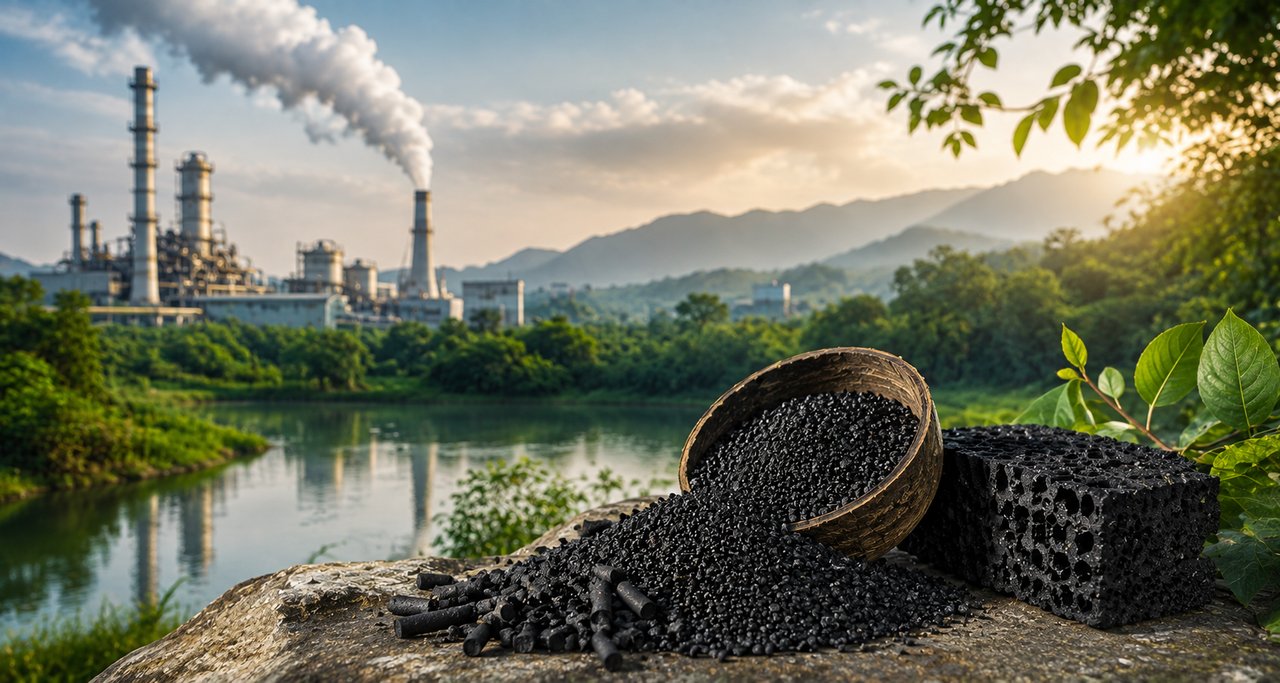
Controlling Air Emissions and VOCs
Industrial processes release volatile organic compounds (VOCs), solvents, odours and hazardous air pollutants that regulators increasingly require plants to capture. Activated carbon adsorbs these compounds onto its pore surface as the gas stream passes through a bed, stripping the air before it is released. Typical applications include solvent recovery in printing and coating lines, odour control at wastewater plants and landfills, and flue-gas treatment where mercury and dioxins must be removed.
Flue Gas and Mercury Control
One of carbon's highest-value environmental roles is mercury capture from coal-fired power plants and waste incinerators. Powdered activated carbon is injected into the flue gas, where it adsorbs vaporised mercury and is then collected in the particulate filter. This is the dominant technology for meeting mercury emission limits, and it turns a low-cost powder into an essential compliance tool for power producers.
Wastewater and Industrial Effluent
On the liquid side, activated carbon removes the organic pollutants, colour and trace chemicals that conventional biological treatment leaves behind. It is used to polish municipal effluent, treat textile and dye wastewater, and remove pharmaceuticals and pesticides that are hard to treat any other way. Granular carbon in columns handles continuous flows; powdered carbon doses directly into the stream for batch or seasonal treatment.
Why the Grade Choice Matters
Environmental applications vary enough that no single carbon fits all. Gas-phase removal favours specific pore-size distributions matched to the compound's molecular size; mercury injection needs a fine powder with fast adsorption kinetics; water polishing needs a granular carbon with the right hardness to survive regeneration. Selecting by application — and verifying with a sample test on your own stream — is the difference between meeting a permit and fighting it.
The common thread is that activated carbon adsorbs what must not be released — organics, odors, color and trace contaminants — across gas and water phases. As regulations tighten in more markets, carbon’s role shifts from a treatment option to a compliance tool, and specifying it correctly (the right grade, the right contact time, verified by testing) is what makes it cost-effective rather than an expensive insurance policy. Buyers who specify and verify this way get compliance at a predictable cost.
FAQ
What does activated carbon remove from air?
VOCs, solvents, odours, mercury and hazardous air pollutants, depending on the grade and system.
How is carbon used for mercury control?
Powdered activated carbon is injected into flue gas to adsorb vaporised mercury, then collected in the particulate filter.
Can activated carbon treat difficult wastewater?
Yes — it removes organics, colour and trace chemicals that biological treatment leaves behind.
Tell us what you need to remove, and we will recommend a carbon matched to your emission-control application.