
Textile printing and dyeing plants face a stubborn environmental problem: highly coloured wastewater loaded with reactive and disperse dyes, surfactants and print-paste residues. These dyes are notoriously difficult to remove because many resist biological degradation and pass straight through conventional treatment. Powdered activated carbon (PAC) is one of the most effective and economical tools for cutting colour and COD from printing effluent before discharge or reuse.
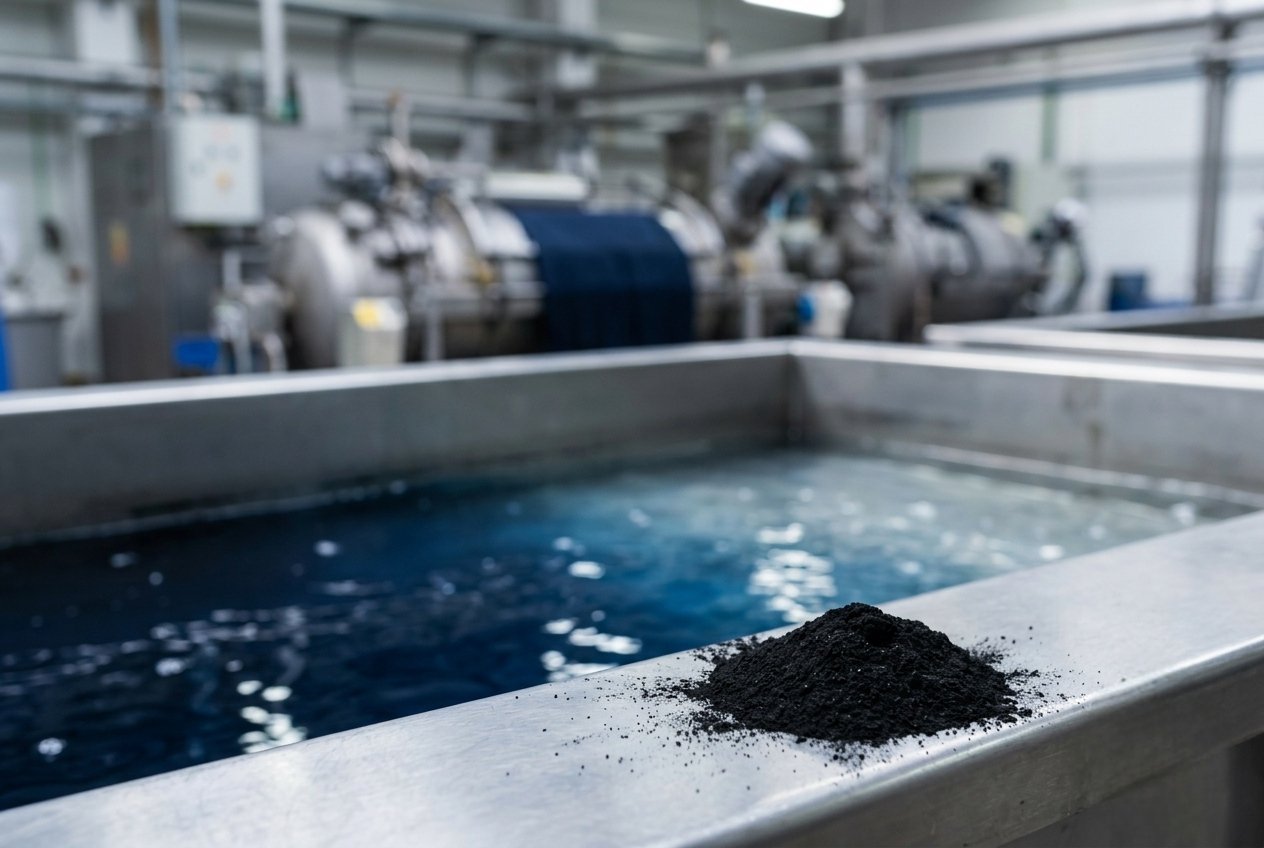
Why Powdered Carbon, and Why It Works
PAC is activated carbon ground to a fine powder — typically 100 to 325 mesh — with an enormous surface area per gram. Added directly to the wastewater, the fine particles adsorb dye molecules and auxiliary chemicals rapidly, then settle or filter out with the sludge. Because the particles are so small, the adsorption kinetics are fast, and the media cost is low compared with granular beds. PAC is especially effective as a final polishing step after biological or coagulation treatment, catching the residual colour that other processes miss.
Choosing the Right PAC Grade
For textile wastewater, the two most important indicators are the molasses number and the methylene blue adsorption value, which reflect the carbon's ability to remove the larger, highly coloured molecules typical of dyes:
Methylene blue adsorption: a high value indicates strong capacity for medium-size dye molecules — aim for at least 12–18 ml/g for reactive dyes.
Molasses number: reflects capacity for large colour bodies; a high value helps with disperse and direct dyes.
Particle size: 200–325 mesh for fast reaction; coarser 100–200 mesh where settling speed matters.
Iodine value: a useful general indicator, typically 500–1000 mg/g for water-treatment PAC.
Dosing and Operating Tips
Start with a jar test to find the optimum dose — most plants fall in the range of 100–500 mg/L depending on colour load. Add PAC at the point of good mixing, allow 20–40 minutes of contact time, then settle or filter. Combining PAC with a low dose of coagulant often improves both colour removal and settling, because the carbon particles act as flocculation nuclei.
Where PAC Fits in the Treatment Train
PAC is most effective when used where its strengths show: as a final polishing step after biological or coagulation treatment, or as an emergency response when colour or odour spikes exceed limits. In a typical printing plant, primary and biological treatment remove the bulk of the load, and a PAC dosing step at the end removes the residual colour and COD that regulators measure at the outfall. This approach keeps PAC consumption — and cost — far lower than using it as the only treatment.
For plants with variable production, PAC is especially practical because dosing can be adjusted instantly to match the current discharge quality. There is no bed to replace, no media to regenerate — just a storage silo, a dosing system and a mixing point. When a new dye with unusual colour enters the process, the jar test tells you in an hour whether your existing PAC dose handles it or whether the grade should be switched.
FAQ
Can PAC be reused after one dose?
In most wastewater duties PAC is used once and removed with the sludge; the spent carbon can be regenerated off-site or co-combusted for energy recovery.
Will PAC remove COD as well as colour?
Yes. Besides dyes, PAC adsorbs many organics that contribute to COD, so a well-designed dose typically cuts COD by 30–60% alongside the colour removal.
Does JYD supply food-grade PAC for printing pastes?
For dye and auxiliary purification where purity matters, JYD supplies wood-based PAC with very low ash and high caramel decolorizing capacity.
Send us a sample of your printing effluent and target discharge limits — JYD will recommend the right PAC grade and dose for your treatment train.