
Gold recovery is one of the few applications where buying the most expensive, highest-iodine carbon can be a mistake. The grade that performs best — and costs least per ounce recovered — depends almost entirely on the process it will serve. Carbon-in-pulp (CIP), carbon-in-leach (CIL) and heap leaching stress the media in very different ways, so the selection rule is simple: choose by process first, then by price.
Why the Process Decides the Grade
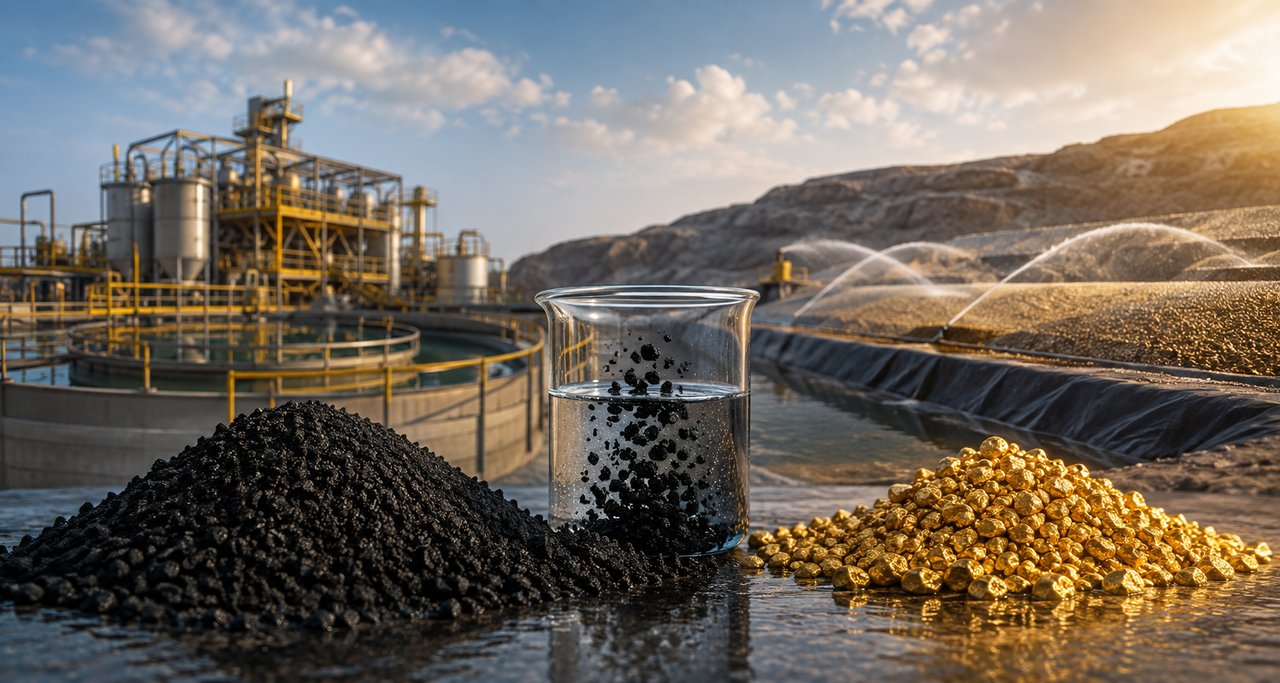
The two mainstream gold-recovery routes differ in how the carbon contacts the gold. In CIP and CIL, the ore is ground, leached with cyanide and mixed with carbon in agitated tanks, where the granules circulate continuously with the ore slurry. In heap leaching, crushed low-grade ore is stacked in large heaps, cyanide solution is sprayed over the top, and the pregnant solution is passed over carbon to recover the gold. Because the two circuits stress the carbon differently, the same grade rarely suits both at minimum cost.
CIP/CIL Circuits: Hardness Is the Non-Negotiable
In a CIP or CIL circuit the carbon is churned against abrasive ore slurry, day after day, for months on end. Carbon that crumbles under that wear turns into fines that either carry gold off the screens or must be replaced — and both losses show up directly on the balance sheet. That is why hardness is the hard requirement: the industry standard for CIP/CIL duty is an abrasion resistance of at least 98%. Coconut-shell carbon is the preferred material because its dense structure delivers that hardness, with an iodine value of 1000 mg/g and above and a 6×12 mesh as the typical specification.
Heap Leach: Low-Concentration Gold Demands High Adsorption
Heap-leach solutions are large volumes of relatively dilute gold, and the carbon must load efficiently from that weak solution. This is where the counter-intuitive part comes in: heap leach usually calls for a higher iodine value, not a lower one. The gold concentration in solution is far below what an agitated circuit contacts, so each granule needs more adsorption capacity to load economically. High-iodine coconut carbon at 1050 mg/g and above is the efficient choice; where cost per tonne dominates, a good nutshell (apricot-shell) carbon at 900–1000 mg/g is the economical fallback.
Coconut or Nutshell: Matching Material to Process
Once the process is fixed, the material choice follows. Coconut-shell carbon offers the highest iodine values and hardness, making it the workhorse for CIP/CIL and for heap leach where efficiency matters more than cost. Nutshell carbon is cheaper, with iodine typically 900–1000 mg/g and hardness around 95% or above — a strong value pick for large-tonnage heap leach operations. The same logic applies if you are buying carbon for a loaded-carbon column or for silver and platinum-group recovery: match the grade to how the carbon will be stressed, not to the highest number on the datasheet.
FAQ
Does heap leach need a higher iodine value than CIP/CIL?
Yes — and it is the opposite of what many buyers assume. Heap-leach solutions are dilute, so the carbon needs more adsorption capacity per granule; 1050 mg/g and above is the efficient choice, while CIP/CIL works well at 1000 mg/g or slightly above.
Why does abrasion resistance matter more in CIP/CIL?
Because CIP/CIL carbon is churned against abrasive ore slurry in agitated tanks for months, so it must resist attrition (≥98%). Heap-leach carbon sits in columns and only contacts clarified solution, so hardness matters less and iodine matters more.
Does JYD supply carbon for both processes?
Yes. JYD supplies coconut gold-recovery carbon for CIP/CIL and heap leach, and cost-effective nutshell carbon for large-tonnage heap-leach operations.
Tell us your process (CIP/CIL or heap leach), ore grade and target iodine — JYD will recommend the right grade with batch test data, within 24 hours.