
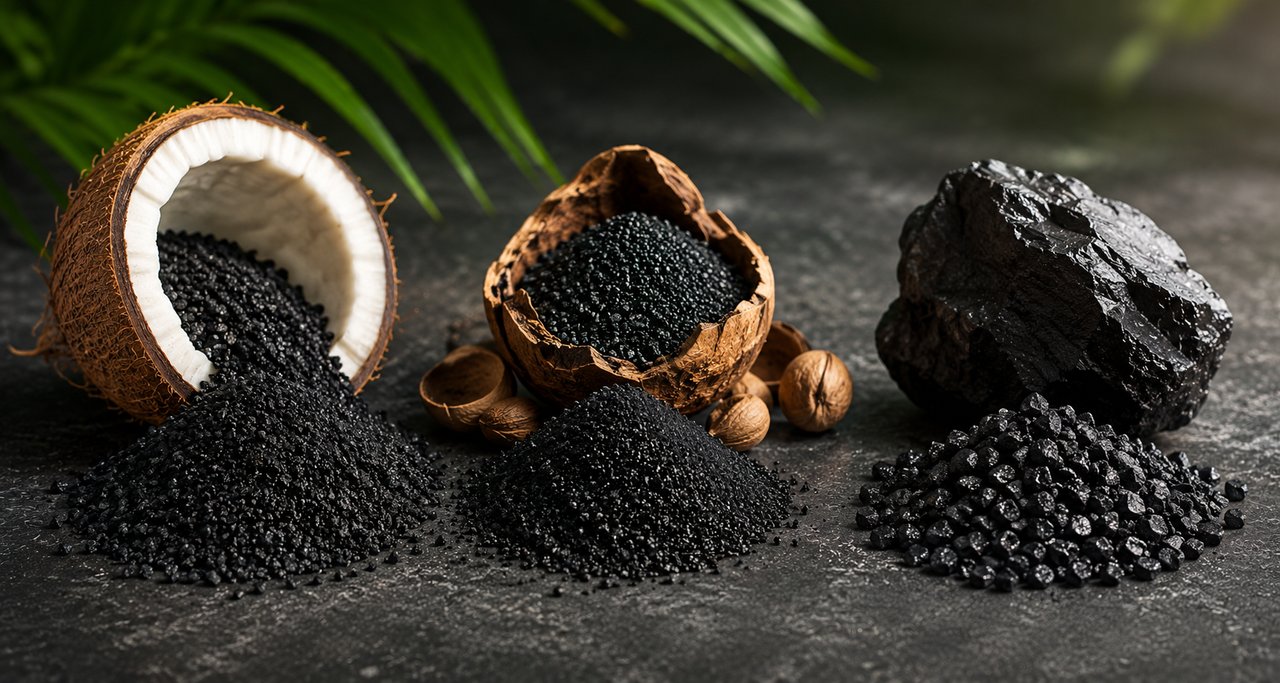
Three families of raw material are used to make activated carbon, and all three have been tried in gold recovery. In practice they behave very differently: coconut shell sets the standard, nutshell (apricot or peach shell) offers a cost-effective middle ground, and coal-based carbon rarely earns its place in a gold circuit. Understanding the differences — and the numbers behind them — is the fastest way to avoid overpaying or under-specifying.
Coconut Shell: The Gold-Standard Workhorse
Coconut-shell carbon is the default for gold recovery for three reasons. Its naturally dense structure delivers the hardness the circuit needs — abrasion resistance of 98% and above — so it survives years of slurry mixing and repeated reactivation. It reaches iodine values of 1000 to 1050 mg/g and beyond, loading the gold–cyanide complex efficiently. And its low ash content, typically 2–4%, keeps the media clean. The trade-off is price: coconut is the most expensive of the three families.
Nutshell Carbon: The Cost-Effective Alternative
Nutshell carbon, made from apricot or peach shells, sits between coconut and coal on almost every measure. Iodine value typically runs 900–1000 mg/g, hardness around 95% or above, and it carries a noticeably lower price than coconut. For heap-leach operations — large tonnage, low-grade ore, where cost per tonne of carbon matters — nutshell carbon is the value pick that still recovers gold efficiently. Its slightly lower hardness makes it less suited to the aggressive mixing of a CIP/CIL circuit.
Coal-Based Carbon: Why It Rarely Fits Gold Recovery
Coal-based carbon is the cheapest and most widely used carbon in water treatment, but it struggles in gold recovery. Its ash content runs 6–15%, far higher than coconut, and its typical iodine values of 500–1100 mg/g sit at the lower end of what a gold circuit wants. More importantly, coal carbon lacks the combination of high hardness and dense micropore structure that gold loading needs, so it appears in gold applications mainly as a low-cost option in carbon columns. For CIP/CIL and heap leach, the extra price of coconut or nutshell buys far better recovery.
Deciding by Process and Budget
The practical rule is short. For CIP/CIL, buy coconut — the hardness is a hard requirement, and 6×12 mesh coconut at 1000+ iodine is the proven standard. For heap leach, choose high-iodine coconut where recovery efficiency and tonnage justify it, or cost-effective nutshell where price drives the decision. Match the material to the stress the circuit puts on the carbon and to your budget, and you avoid both overpaying and leaving gold behind.
FAQ
Is coconut carbon worth the higher price for gold recovery?
For CIP/CIL, yes — the hardness prevents carbon loss that costs far more than the price difference. For cost-sensitive heap leach, a good nutshell grade can be the smarter buy.
Can coal-based carbon recover gold?
Coal carbon is used in some carbon-column applications for cost reasons, but its higher ash and lower hardness make it a poor fit for CIP/CIL and heap leach.
Does JYD supply both coconut and nutshell gold carbon?
Yes. JYD supplies coconut gold-recovery carbon for CIP/CIL and heap leach, and apricot-shell nutshell carbon for large-tonnage, cost-driven operations.
Tell us your process, ore grade and monthly volume — JYD will recommend coconut or nutshell with batch test data and a quotation.