
Every gold plant buys carbon on a datasheet, but the numbers on that datasheet decide how much gold is recovered, how long the carbon lasts and what the circuit costs to run. Iodine value, hardness and mesh size are the three specifications that matter most, and knowing what each one really means separates a well-specified buy from a costly one.
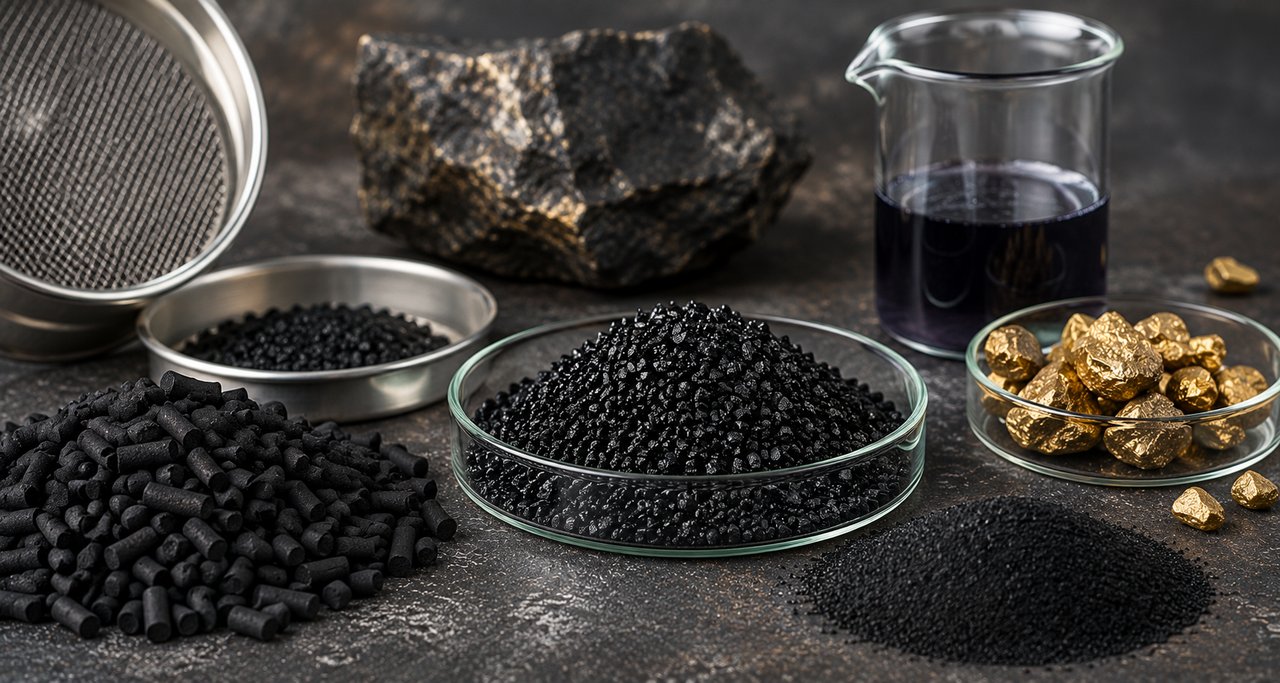
Iodine Value: The Adsorption Capacity
Iodine value estimates the total surface area available for adsorption, reported in mg/g. For gold recovery, 1000 mg/g and above is the standard for CIP/CIL duty, with 1050+ preferred where fast loading and good reactivation economics matter. Heap leach, working with dilute solution, can justify an even higher iodine grade. But iodine is not everything: a high-iodine carbon with poor hardness will lose more value to fines than a slightly lower-iodine carbon that survives the circuit.
Hardness: The Cost Driver Buyers Underrate
Hardness measures how well the granules resist abrasion and crushing, reported as a percentage. In a CIP/CIL circuit the carbon is mixed against ore slurry continuously, so an abrasion resistance of at least 98% is the practical standard. Every point of hardness lost means more carbon fines, more gold carried away on screens and more frequent replacement — and replacement is typically the largest operating cost in the gold circuit. A carbon that can be reactivated and reused many times because it stays intact is worth more over its life than a cheaper grade that turns to dust.
Mesh Size: Matching the Granule to the Screen
Mesh size defines the particle-size range. 6×12 mesh means granules that pass a 6-mesh screen but are retained on a 12-mesh screen — roughly 1.7 to 3.35 mm — and it is the standard for gold recovery because such granules adsorb quickly and are easily captured on the plant's screens. Mesh should be matched to your screen aperture: too coarse and the carbon passes through or blinds the screens; too fine and it is lost to the slurry. A particle-size specification of 95% or more within the declared range is the uniformity indicator that keeps the moving bed stable.
What Else the Datasheet Should Show
Three further numbers are worth checking before you commit. Apparent density, typically 0.45–0.55 g/ml, affects slurry loading and how much carbon fits a given tank or column volume. Moisture, normally 10% or below, is weight you should not pay for. Ash content reflects purity and matters if you buy certified or reactivated carbon. Finally, insist on per-batch test data — iodine, hardness, mesh and moisture for every shipment — because batch-to-batch consistency is what lets the plant run without retuning the circuit.
FAQ
Why does hardness matter so much in gold recovery?
Soft carbon crumbles into fines during slurry mixing, losing gold and shortening bed life. Hard carbon (≥98%) survives more reactivation cycles, directly lowering the largest operating cost in the circuit.
What is the difference between 6×12 and 8×16 mesh?
Both are used for gold recovery. 6×12 mesh (about 1.7–3.35 mm) is the most common choice; 8×16 mesh is finer, so it adsorbs a little faster but needs tighter screening. Pick the one that matches your screen aperture and circuit design.
Do you supply batch test certificates with gold-recovery carbon?
Yes. JYD tests every batch and ships the data — iodine, hardness, mesh, moisture and ash — with each order, and third-party testing is available on request.
Send us your process, screen aperture and target specification — JYD will confirm the right gold-recovery grade with full batch data.