
Heap leaching recovers gold from ore that is too low-grade for a conventional mill: crushed rock stacked in enormous heaps, cyanide solution sprayed over the top, and the pregnant solution collected and passed over activated carbon. It is a volume game — big tonnage, tight margins — so the carbon choice has to balance recovery against cost more carefully than in any other gold application. Here is what actually matters.
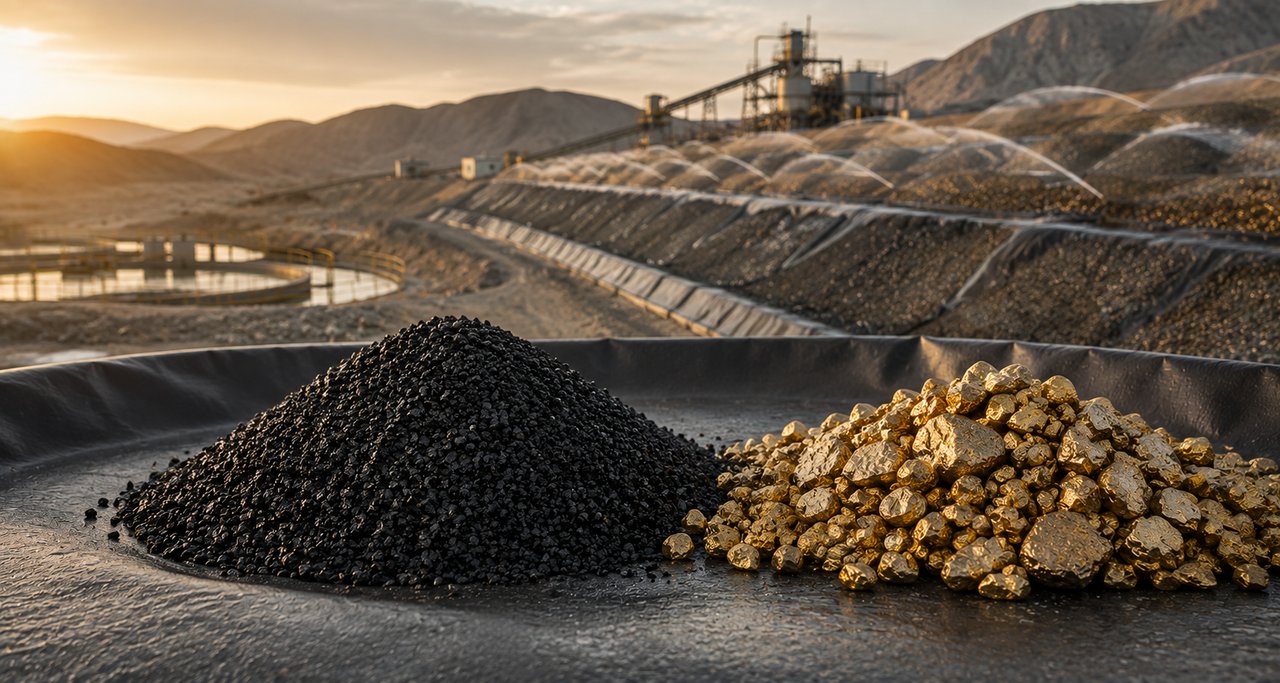
How Heap Leach Differs from CIP/CIL
In CIP and CIL circuits the carbon is mixed directly with the ore slurry in agitated tanks; in heap leach the carbon sits in loaded columns or tanks and only the clarified solution passes over it. That difference changes the specification. There is little mechanical abrasion on the carbon, so extreme hardness matters less — but the gold in solution is far more dilute, which puts the emphasis squarely on adsorption capacity and on the cost per tonne of media.
Why Heap Leach Needs Higher Iodine, Not Lower
This is the point that surprises most buyers. Because the gold concentration in heap-leach solution is low, the carbon needs a high adsorption capacity to load efficiently — so high-iodine carbon performs best, not a cheap low-iodine grade. For efficiency, high-iodine coconut carbon at 1050 mg/g and above is the proven choice. Where the operation is very large and cost-sensitive, a good nutshell (apricot-shell) carbon at 900–1000 mg/g recovers gold effectively at a lower price. The rule is the reverse of the common assumption: dilute solution favours higher iodine, not cheaper carbon.
Mesh, Handling and Loss at Scale
Because heap-leach carbon is handled in volume, particle size and attrition matter more than a laboratory datasheet suggests. Coarser granules — such as 4×8 or 6×12 mesh — flow well through columns and are easy to screen and reclaim. Uniform particle size, with 95% or more within the declared range, keeps the columns stable and predictable. And at this scale, carbon loss in handling is a real cost: choose a grade that resists attrition, and handle it gently in transfer and screening so fines do not quietly eat the media budget.
Regeneration Keeps the Cost Down
The economics of a heap-leach operation turn on how many times the carbon can be reused. Good coconut carbon, and especially water-polished grades, can be regenerated and returned to service repeatedly before replacement. That regenerability is worth more than a few dollars of purchase price, because replacement — not purchase — is the cost that compounds over a long mine life. Ask for batch test data and run a regeneration trial before committing to volume.
FAQ
Why not use the cheapest carbon for heap leach?
Heap-leach solutions are dilute, so the carbon needs high adsorption capacity to load gold efficiently — a cheap low-iodine carbon leaves gold behind in solution.
Which mesh is best for heap-leach carbon columns?
Coarser meshes such as 4×8 or 6×12 flow well and are easily screened and reclaimed; match the mesh to your column and screen design.
Can heap-leach carbon be regenerated on site?
Good coconut and water-polished grades can be regenerated multiple times, which is the single biggest lever on media cost at heap-leach scale.
Send us your heap dimensions, solution grade and target recovery — JYD will recommend the right coconut or nutshell carbon with batch data and a quotation.